Garden Stones and Pebbles: How to Choose, Calculate and Lay Them
Decorative stone is one of the few landscaping decisions you make once. Get the size, colour and depth right and it will still look good in fifteen years. Get it wrong and you are either shovelling it back into a barrow or living with a garden bed that shows bare ground every summer.
This guide covers how to choose garden stones for the job you actually have, how to work out how much you need, and how to lay them so they stay where you put them. It is written for Melbourne conditions: heavy clay in the west, hot dry summers, wet winters and it is based on what we supply and what our customers come back and tell us.
Garden Pebbles, Stones and Gravel: What the Terms Actually Mean
The terms get used interchangeably, and that is where most ordering mistakes start. In practical terms:
- Pebbles are rounded. They have been tumbled smooth by water, either in a river or through processing. They shift underfoot and do not lock together.
- Crushed or graded stone has been mechanically broken, so the edges are angular. Angular pieces knit together and stay put on a slope far better than rounded ones.
- Garden gravel generally means smaller loose aggregate, typically under 10mm. Pea gravel is the common example.
- Rocks or oversize stone are feature pieces, usually 100mm and up, placed individually rather than spread.
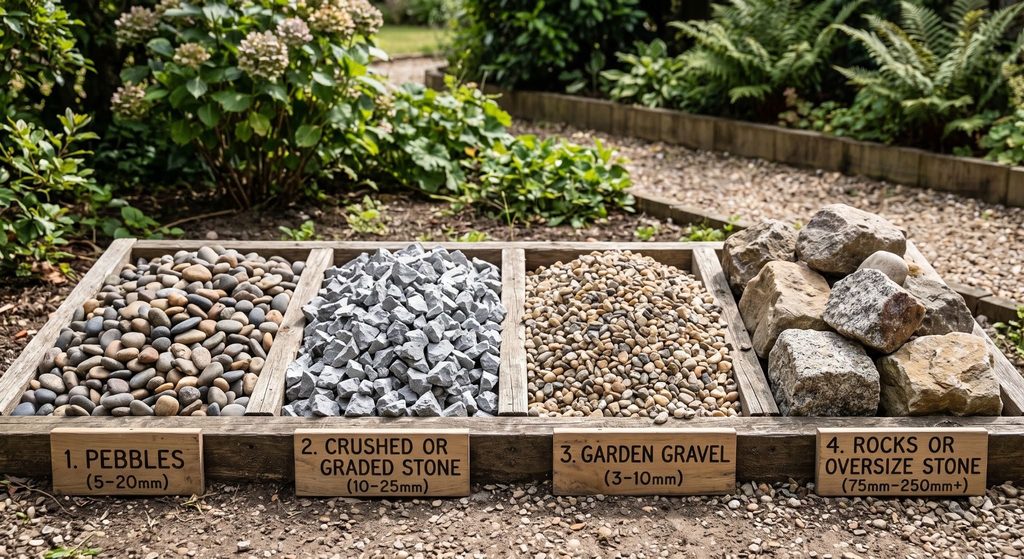
The distinction that matters most on site is rounded versus angular. Rounded pebbles are the better choice for garden beds, water features and anywhere the look is doing the work. Angular stone is the better choice for paths, slopes and anywhere feet, wheels or water will be moving across the surface.
If you want the technical detail on how crushed aggregate differs from gravel, we have covered that separately in Crushed Stone Aggregate vs Gravel.
SoilWorx Garden Stones & Decorative Pebbles
Our decorative range is supplied under the Stylescape brand. Here is what we stock and what each one is genuinely best at.
Garden Gravel and Fine Pebbles: 5mm to 7mm
| Product | Description | Best for |
| Pea Gravel 5–7mm | Small, smoothly rounded gravel, named for the resemblance to peas | Pot topping, narrow side paths, drainage layers, courtyard fill |
| Utopia® 7mm | Small river pebble, sometimes sold elsewhere as “pea gravel” or “white gravel”. Greys, browns, yellows and whites | Fine-textured beds, pot topping, tight spaces where 20mm looks coarse |
Fine grades read as a texture rather than as individual stones. They are the right choice in small courtyards and against modern architecture. They are the wrong choice on any slope, and they travel readily on the soles of shoes.
Garden Stones and Pebbles: 20mm
This is the workhorse size and where most garden bed projects land.
| Product | Description | Best for |
| Safari® 20mm | Graded sandstone with rugged, irregular edges. Yellow, gold and red with pink and purple notes. Widely known as Tuscan stone. Our most popular small garden rock | Warm-toned beds, paths, anywhere you want the stone to stay put |
| Utopia® 20mm | Natural river pebble. Grey, white, yellow and brown, with quartz and mica veins that catch the light | Rounded, softer look in beds and borders |
| Oriental Spark® 20mm | Granitic, rugged surfaces in dark grey and white, with quartz and mica veins running through | Contemporary schemes, strong contrast against pale paving or rendered walls |
| Arctic Quartz 20mm | Premium natural quartz aggregate. Brilliant white, highly abrasion resistant and hard-wearing | Feature beds where whiteness needs to last, high-traffic decorative areas |
A note on white stone, because it is the most common source of disappointment. Whiteness is a function of the parent rock, not a coating. Arctic Quartz is genuine quartz, which is why it holds its colour and resists abrasion. Softer white stones dull faster, particularly under trees or near a driveway.
Large Landscaping Stones and Feature Rocks: 30mm and Above
| Product | Description | Best for |
| Safari® 30–80mm | The larger grade of the Safari sandstone family. Same warm angular character | Dry creek beds, coarse-textured beds, transitions between zones |
| Utopia® 30–80mm | Limestone river pebble with a cool tone, greys and whites with pops of brown and yellow | Dry creek beds, pond surrounds, planter features |
| Natural Charm® River Rocks | Blend of river pebbles in dark brown, light brown, grey and blue, in a standard size range | Naturalistic beds, water features, softening hard edges |
| Natural Charm® Oversize | The same blend in a substantially larger size range | Feature placement, erosion control, focal points |
| Safari Oversize | Sandstone with angular structure and warm sunset colouring. Resists compaction, so drainage stays good | Gabion systems, retaining walls, steps, water features |
| Oriental Spark® 50mm | Granitic, dark grey and white with quartz and mica veins that glisten in sunlight | Bold contrast, feature beds, modern water features |
What Size Garden Stones Should You Choose?
Size selection comes down to three questions.
How big is the area?
Large stone in a small bed makes the bed look smaller and reads as clutter. Fine gravel across a big open area reads as nothing at all. As a rough guide, courtyards and narrow borders suit 7mm to 20mm; open beds and larger front gardens carry 20mm to 80mm comfortably.
Will anyone walk on it?
Rounded pebble underfoot is unstable and unpleasant to walk on above about 20mm. If the surface will take regular foot traffic, use an angular graded stone, or a compacting topping product rather than a decorative pebble.
Is there a slope?
Rounded pebble migrates downhill. Angular stone interlocks and holds. On anything steeper than a gentle fall, choose angular and install proper edging.
Still deciding between two products?
Send us your project details and we will tell you which one suits the application.
How Much Garden Stone Do You Need? Coverage per Square Metre
This is where most orders go wrong, and the arithmetic is genuinely simple. Volume is area multiplied by depth.
Volume in cubic metres = length (m) × width (m) × depth (m)
A bed 4m long and 2.5m wide at 50mm deep is 4 × 2.5 × 0.05 = 0.5 cubic metres.
Working from the other direction, here is exactly how far one cubic metre goes at each common depth:
| Depth | Coverage per cubic metre |
| 30mm | 33.3 m² |
| 40mm | 25.0 m² |
| 50mm | 20.0 m² |
| 75mm | 13.3 m² |
| 100mm | 10.0 m² |
Those figures are geometry, not estimates, so they hold for any product. What varies between products is weight per cubic metre, which depends on the parent rock and the grade. If you are ordering by the tonne rather than the cubic metre, ring us and we will give you the conversion for the specific product you have chosen rather than a generic figure.
Two practical adjustments worth making before you order:
- Add roughly 10%. Beds are rarely true rectangles, ground is rarely level, and a small shortfall means a second delivery for a fraction of a cubic metre. Order the extra.
- Measure irregular beds in sections. Break a curved bed into two or three rectangles, calculate each, and add them. It is faster and more accurate than trying to be clever about the curve.
Skip the arithmetic: work out your exact quantity with the Soilworx volume calculator before you order.
How Deep Should Garden Stones Be Laid?
Too shallow is the single most common installation fault. A thin layer lets the substrate show through within a season, does nothing for weed suppression, and looks patchy the moment anything disturbs it.
Rule of thumb: the layer should be at least two to three times the nominal stone size. For 20mm stone, that means 40mm to 60mm, which is why 50mm is the standard specification for garden beds.
For our Safari Tuscan stone we recommend:
- Pathways: 50mm to 75mm
- Driveways: 75mm to 100mm
For decorative garden beds, 50mm is the working minimum. Going deeper than about 75mm in a bed rarely improves the appearance and simply costs more.
Oversize and feature stone is different. Those pieces are placed individually as single-layer features, so depth is effectively the size of the stone.
One important caveat on driveways. Loose decorative pebble is not a driveway surface, it rearranges under tyres and ends up on the footpath. For driveways you want a compacting product laid over a properly prepared base, which is what our Path n Drive and toppings range is for. Decorative stone belongs beside the driveway, not on it.
How to Lay Garden Pebbles and Stones: Step by Step
1. Clear and level. Remove existing vegetation, roots and any old mulch. Any perennial weed left in place will find its way back through.
2. Sort out drainage first. This matters more in Melbourne’s west than almost anywhere else, because the basalt-plain soils across suburbs like Deer Park and Werribee are heavy clay that drains slowly. A stone layer over unimproved clay does not fix drainage; it creates a reservoir that sits against plant roots through winter. If water pools in the area now, deal with that before you spread anything decorative over the top. Our team can talk you through the right drainage aggregate for the situation.
3. Install edging before the stone, not after. This is the step most people skip and most regret. Without a defined edge, stone migrates into lawn, where it becomes a genuine hazard for anyone with a mower. Steel, masonry, concrete or stone edging all work. Set the edge slightly proud of the finished stone level so the stone sits contained.
4. Lay a woven geotextile weed mat. Woven geotextile, not black plastic; plastic stops water from reaching the soil and will kill plants. Overlap the joins generously and pin it down. Cut crosses for existing plants rather than large holes.
Be realistic about what weed mat does. It stops weeds coming up from the soil beneath. It does not stop seed blowing in and germinating in the leaf litter and dust that accumulates on top of the stone over the years. Weed mat buys you several good years, not permanent freedom.
5. Spread to depth and rake level. Work in from the edges. Check depth in a few places with a stick rather than trusting your eye.
6. Hose it down. Natural quarried products carry sand and dust residue from rubbing and transport. A wash-down brings the colour up immediately and is the difference between a finished job and a dusty one. Expect this, it is normal, not a fault.
Ordering more than a few cubic metres, or tight on site access? Ask us about bulka bags and delivery options.
Garden Stones vs Organic Mulch: Which Should You Use?
We supply both, so we have no reason to push you either way. They do genuinely different jobs.
| Decorative stone | Organic mulch | |
| Lifespan | Effectively permanent | Breaks down, needs topping up |
| Feeds the soil | No | Yes, as it decomposes |
| Moisture retention | Good | Good, and improves soil structure over time |
| Weed suppression | Good over geotextile | Good, but weeds germinate in it as it breaks down |
| Summer heat | Absorbs and re-radiates heat, pale colours less so | Insulates, keeps root zone cooler |
| Cost pattern | Higher once | Lower, repeated |
| Fire risk near buildings | Non-combustible | Combustible |
Choose stone for permanent structural plantings, natives, succulents, driveway borders, pot toppings, paths and any bed you do not want to re-do every couple of years.
Choose organic mulch for vegetable gardens, annual beds, new plantings that need help establishing, and anywhere soil improvement is part of the goal. If you are weighing this up in detail, our guide on the purpose and benefits of mulch goes further into it.
Plenty of gardens use both, stone in the front garden and along the driveway, organic mulch in the productive beds out the back.
When Garden Stones Are the Wrong Choice
Worth saying plainly, because most suppliers will not. Avoid stone as a ground cover in vegetable beds and annual displays, where you will be digging constantly and where the soil needs feeding. Avoid dark stone in tight beds against a north or west-facing wall in full sun, because you are building a heat trap. Avoid rounded pebble on any slope or beside a lawn edge without proper containment. And avoid it directly under deciduous trees unless you are prepared to blow leaves off it every autumn, because raking leaf litter out of stone is a genuinely tedious job.
Garden Stones in Melbourne: Summer Heat and Bushfire Considerations
Summer heat. Stone stores heat during the day and releases it into the evening. Pale stone reflects more and heats less; dark basalt and dark granitic stone absorb more. In a small, enclosed, sun-facing courtyard, the difference is noticeable, both for the plants and for anyone sitting out there. If the area gets hard afternoon sun, lean towards the paler products.
Bushfire. If you are in a bushfire-prone area, this is not a minor consideration. The CFA’s Landscaping for Bushfire guidance advises avoiding flammable mulches within the defendable space around a building, and specifically names gravel, scoria, pebbles, shells and recycled crushed brick as non-combustible alternatives that serve the same purpose. CSIRO’s bushfire landscaping guidance says the same. If your property is in a Bushfire Management Overlay, check your permit conditions; mineral ground cover close to the building is often the sensible choice regardless.

Garden Stones and Pebbles: Frequently Asked Questions
How much garden stone do I need per square metre?
At the standard 50mm depth, one cubic metre covers 20 square metres. So a square metre needs 0.05 cubic metres. Multiply your area by 0.05 for a 50mm finish, or use our volume calculator.
What size pebble is best for garden beds?
20mm is the most reliable choice for most beds. It is large enough to stay put, small enough to spread evenly, and it suits the scale of a typical residential bed. Drop to 7mm in courtyards and small borders; go to 30–80mm where you want a coarser, more naturalistic finish.
Do I need weed mat under garden stones?
Yes, for any bed you want to stay tidy. Use woven geotextile rather than plastic sheeting so water and air still reach the soil.
Can I lay garden pebbles straight onto soil?
You can, but they will sink into it and mix with it, and you will lose both the depth and the clean look within a season or two. A geotextile layer keeps the stone as a distinct layer.
Will garden stones stop weeds completely?
No. Nothing does. Stone over geotextile at proper depth dramatically reduces weeding, and the weeds you do get pull out easily because they are rooted in shallow surface debris rather than soil.
How long do garden stones last?
Indefinitely. They do not decompose. You may need to top up occasionally where stone has migrated or settled, and you will want to hose or blow debris off periodically, but you are not replacing the material.
Can I use decorative pebbles on a driveway?
Not as the running surface. Loose pebbles displace under tyres. Use a compacting topping product over a prepared base for the driveway itself, and keep decorative stone to the borders.
Do you deliver garden stones across Melbourne?
Yes, with GPS-tracked delivery through SubTrux so you get an SMS when your order is on the way. We supply everything from bagged quantities through to bulk loads, plus bulk bags where site access is limited. You are also welcome to collect from any of our three stores.
Buy Garden Stones and Pebbles in Melbourne
Choosing decorative stone from photographs on a screen is difficult. Colour reads differently in the yard, in the sun, and next to your actual paving and render. If you are within reach of Deer Park, Pakenham or Werribee, come and look at it in person, our counter staff have specified these products across thousands of Melbourne gardens and will tell you honestly if the one you have picked is wrong for the application.
With over forty years supplying sands, soils, gravels, mulches, pebbles and bulk foundation materials across Victoria, we would rather get your order right the first time than sell you a second load.
- Ready to choose? Browse the garden stones and pebbles range
- Need to know how much? Use the volume calculator
- Not sure what suits your site? Send us your project details
- Landscaper or builder? Apply for a Soilworx trade account