Different Types of Soil: The Ultimate Guide to Understanding Australia’s Diverse Soil Types
Here at Soilworx, we know that whether you’re laying a slab for a new home, constructing a major civil project, or simply planting a flourishing garden, it all starts with the soil. But in a continent as vast and geologically complex as Australia, “the soil” is never just one thing.
From the expansive, moisture-retaining red clays of Victoria to the arid, sandy washes of our coastal regions, Australia’s diverse soil types present unique challenges and opportunities. Ignoring the specific nature of your earth, its texture, its chemistry, and its tendency to swell or shrink, can lead to poor plant growth, drainage failures, or, worse, major structural issues down the line.
In this ultimate guide, we’re peeling back the layers of the Australian landscape. We’ll give you the expert knowledge needed to identify exactly what’s underfoot, understand the crucial differences between classifications like “Podzols” and “Reactive Clays,” and learn the practical steps required to manage or amend your specific soil type. Let’s dig in and master the foundation of your next project.
What Is Soil?
We know that to most people, soil is just… dirt. But in the world of landscaping, civil construction, and gardening, soil is the single most important material you work with. It’s the literal foundation of every successful project.
So, what is it, really?
Soil is a Complex Ecosystem, Not Just Dirt!
Before we explore the various types of soil, it’s important to understand what soil actually is and why it’s so crucial for your garden.
In simple terms, soil is the loose material that covers the Earth’s surface, distinct from solid rock. It can include a wide range of deposits, such as clay from lakes, silt, sand from dunes, estuary mud, or even boulder clay. Essentially, soil forms the thin, living layer that sits between the solid rock beneath and the air above.
For gardeners and farmers, however, soil usually refers to the top 30–40 cm of ground where seeds are planted and plants grow. Scientifically, soil can extend much deeper, often up to 1.5–2 meters, comprising layers of mineral and organic matter that influence fertility and structure.
When it comes to gardening, the most important layer is the topsoil. This is the dark, crumbly layer at the surface that makes your hands look “dirty” when you touch it. Topsoil is made up of a mix of sand, silt, and clay particles, along with decomposed organic matter, small stones, and networks of plant roots. Its rich colour comes from humus, the decayed organic material that binds with minerals and nutrients to feed plants. Topsoil also hosts countless microorganisms and insects that break down organic matter, further enriching the soil.
Knowing the makeup and characteristics of your topsoil is essential for selecting suitable plants and taking steps to improve soil health, ultimately supporting stronger growth and a thriving garden.
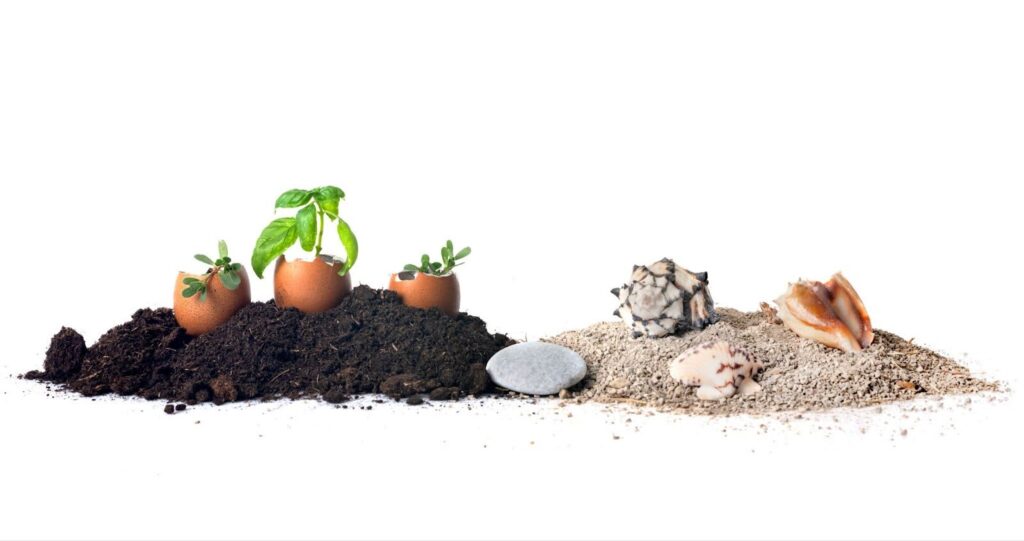
Soil is a complex, dynamic medium composed of four key components: approximately 45% Mineral Matter, 25% Water, 25% Air, and 5% Organic Matter.
The mineral matter provides the structural skeleton, defined by the ratio of sand (the largest particles, excellent drainage), silt (medium particles, moderate retention), and clay (the smallest particles, high nutrient retention but poor drainage). The air and water occupy the spaces (porosity) and are critical for root respiration and nutrient transport, respectively. Finally, the small but vital Organic Matter (including humus, microbes, and decaying material) binds the mineral components, retains moisture, and supplies the bulk of the essential nutrients needed for plant health and improving soil structure.
How Soil Forms: Understanding the Process of Soil Formation
Soil is far from being a static material; it is a dynamic, ever-evolving natural resource. The formation of soil is a slow process shaped by the interaction of geology, climate, biology, topography, and time. This transformation can take hundreds or even thousands of years, resulting in the diverse soil types we find today.
Parent Material: The Foundation of Soil
The parent material is the original rock or sediment from which soil develops. This can include solid bedrock like granite, basalt, or limestone, as well as loose deposits such as river sediment, volcanic ash, or wind-blown sand.
Impact on Soil: The type of parent material influences the soil’s mineral content, colour, and texture. For instance, soils derived from iron-rich basalt produce the deep red, fertile Krasnozems found in parts of Australia.
Climate: The Engine Behind Soil Formation
Climate plays a crucial role in breaking down parent material through a process called weathering.
| Type of Weathering | Primary Mechanism | Impact on Rock / Soil Formation | Australian Relevance |
| Physical Weathering | Temperature fluctuations, freezing/thawing cycles, and wind action. | Breaks down parent rock into smaller mineral fragments (sand and silt). | Important in arid and wind-exposed regions. |
| Chemical Weathering | Reaction with water (often acidic rainwater) that dissolves minerals and alters chemical composition. | Leads to highly weathered and chemically poor soil profiles, dissolving away key nutrients over time. | Accelerated in warm, wet climates, contributing to the formation of ancient, nutrient-poor soils like Laterites across Australia. |
Organisms: Life in the Soil
Soil is teeming with life, from burrowing animals to bacteria, fungi, and plant roots.
Role in Soil Formation: Organisms contribute organic matter (humus) to the mineral framework of soil. Plant roots help break down rock, while microbes decompose leaves and animal waste, releasing nutrients and improving soil structure. This activity creates the rich, dark topsoil essential for plant growth.
Topography: How Land Shape Affects Soil
The shape and slope of the land influence water movement, erosion, and soil depth.
Impact on Soil: Steep slopes often have thin, dry, and eroded soils due to rapid water runoff. In contrast, flat areas and valleys allow water and organic matter to accumulate, forming deeper, more fertile soils.
Time: The Slow Creation of Soil
Soil formation is a gradual process. It can take 500 to 1,000 years to develop just an inch of topsoil.
Impact on Australian Soils: Australia’s soils are among the oldest in the world. Many have been extensively weathered over millions of years, which is why native soils are often shallow and low in nutrients compared to younger soils found in other regions.
Universal Soil Types
Understanding the texture and composition of your soil is crucial because it dictates drainage, nutrient retention, and aeration. These are the primary factors affecting plant health.
| Soil Type | Feel/Texture | Drainage | Nutrient Content | Key Characteristic | Ideal Gardening Use |
| Sandy Soil | Gritty, falls apart easily. | Rapid (poor retention) | Low | Warms up quickly, prone to leaching. | Root vegetables (carrots), drought-tolerant plants. |
| Clay Soil | Sticky when wet, hard/cloddy when dry. | Poor (high retention) | High | Prone to compaction and waterlogging. | Roses, fruit trees, and shrubs (with amendments). |
| Silty Soil | Smooth, soft, and soapy. | Moderate | High | Highly fertile, prone to erosion and compaction. | Most vegetables, grasses, and ornamentals. |
| Loamy Soil | Soft, crumbly (the perfect mix). | Ideal (well-balanced) | High | Excellent structure, the Gold Standard. | All-purpose: most vegetables, flowers, lawns. |
| Peaty Soil | Spongy, light, dark brown/black. | Good (excellent water retention) | Low mineral, high organic matter | Naturally acidic (low pH). | Acid-loving plants (blueberries, rhododendrons). |
| Chalky Soil | Often shallow and stony. | Free-draining | Low (nutrients bound by high pH) | Alkaline (high pH) due to calcium carbonate. | Alkaline-tolerant plants (lavender, clematis). |
| Saline Soil | Varies, often with a white crust. | Varies, often impacted by high water table. | Inhibited (high salt levels) | High concentration of soluble salts. | Salt-tolerant (halophytic) plants only. |
Comprehensive List of Soil Types Explained by Horizon/Layer
Understanding soil by its horizons, or natural layers, helps explain how soil forms and why different depths behave differently. Each horizon plays a unique role in supporting plant growth and overall soil health.
Topsoil (A Horizon)
The topsoil is the uppermost layer and the most important for gardening and agriculture. It contains a mix of minerals, organic matter, microorganisms, and nutrients that plants rely on. This layer is typically darker in colour due to high humus content and is where most root activity, decomposition, and biological processes occur.
Subsoil (B Horizon)
Subsoil sits directly beneath the topsoil. It contains fewer organic materials but is often richer in minerals like iron, clay, and calcium. While it is more compact and less fertile, the subsoil plays a key role in water storage, root support, and nutrient movement from deeper layers to the topsoil.
Parent Material (C Horizon)
The parent material is the layer from which the upper soil horizons develop. It consists of partially weathered rock, sediment, or mineral deposits. Parent material defines the original mineral makeup, texture, and structure of the soil and directly influences how the soil evolves over time.
Organic Soil / O Horizon
The O Horizon, also known as the organic layer, is made up of decomposed leaves, plants, and other natural debris. This layer is rich in organic matter and is commonly found in forests, wetlands, and areas with dense vegetation. It helps feed the soil, improves moisture retention, and contributes to the fertility of the layers below.
The 15 Official Australian Soil Orders
The definitive, current list of all Soil Orders in the Australian Soil Classification (ASC) is:
*A soil order is the highest-level category in soil classification, grouping soils with similar key physical, chemical, and morphological characteristics.
- Anthroposols (Soils profoundly modified by human activity)
- Arenosols (Newly added, deep sandy soils)
- Calcarosols
- Chromosols
- Dermosols
- Ferrosols
- Gleyosols (Sometimes listed as Hydrosols in some resources, but they are distinct)
- Hydrosols
- Kandosols
- Kurosol
- Organosols
- Podosols
- Rudosols
- Sodosols
- Tenosols
- Vertosols
| Order | Defining Characteristics | Key Insight |
| Anthroposols | Soils resulting from human activity (mining, landfill, urban fill). | Man-made or profoundly altered. |
| Arenosols | Very deep sandy soils (at least 1m deep) with little profile development. | The newest addition to the ASC. |
| Calcarosols | High calcium carbonate (lime) throughout the profile. | Common in the Mallee; high pH. |
| Chromosols | Texture contrast soils; pH > 5.5 in subsoil; not sodic. | High agricultural value; “Goldilocks” soils. |
| Dermosols | Structured soils without a sharp texture contrast. | Highly productive, versatile soils. |
| Ferrosols | High iron content; usually red/brown and well-structured. | Former “Krasnozems”; great for potatoes/veg. |
| Hydrosols | Saturated with water for at least 2–3 months a year. | High water table; prone to anaerobic conditions. |
| Kandosols | Massive (unstructured) soils; no sharp texture contrast. | “Red, Yellow, and Grey Earths.” |
| Kurosols | Texture contrast soils; highly acidic (pH < 5.5) in subsoil. | Prone to aluminum toxicity. |
| Organosols | Dominated by organic materials (peat/muck). | Found in swamps/highlands; high carbon. |
| Podosols | Feature a bleached layer and a “B” horizon of accumulated Al/Fe/Organic matter. | Often called “Coffee Rock” soils. |
| Rudosols | Minimal development; very young or very shallow. | Rocky hillsides or fresh sediment. |
| Sodosols | Texture contrast soils with high sodium (sodic) subsoils. | Poor structure; prone to “tunnel” erosion. |
| Tenosols | Weakly developed; usually sandy or loamy. | More developed than Rudosols, less than others. |
| Vertosols | Cracking clay soils; shrink/swell properties. | Iconic “Black Earths”; very fertile but tricky. |
Soil Origins: The Different Soil Types and How They Are Created
Alluvial Soil (river deposits)
Colluvial Soil (gravity-moved soil)
Aeolian Soil (wind-blown sand or dust)
Volcanic Soil / Andisols
Glacial Soil
Desert Soil
Lacustrine Soil (lake deposits)
Marine Soil (coastal areas)
Soil Types Used in Construction & Engineering
In construction and geotechnical engineering, soil classification focuses heavily on particle size, strength, compressibility, and water sensitivity, as these factors directly impact foundation stability, load-bearing capacity, and construction methods.
Here is a table summarizing the common soil types encountered in engineering projects:
| Soil Type | Key Characteristics | Engineering Significance | Suitability & Limitations |
| Gravel Soil | Large, coarse particles | Excellent drainage; low compressibility; high bearing capacity when confined. | Excellent foundation material and road base. Not suitable as a compacted impermeable layer (e.g., dam core). |
| Sand Soil | Coarse particles feel gritty. | Good drainage; medium to high bearing capacity; easily compacted. | Excellent for backfill, road base, and concrete aggregate. Prone to liquefaction when loose and saturated in seismic areas. |
| Silt Soil | Fine particles ($0.002\text{ mm}$ to $0.075\text{ mm}$); feels smooth/floury. | Low permeability; moderate compressibility; high frost susceptibility (prone to freeze-thaw damage). | Good for compacted earthworks (e.g., non-cracking dam cores). Very poor foundation material, especially when wet, due to strength loss. |
| Clay Soil | Very fine particles feel sticky when wet. | Very low permeability; high strength when dry/compacted; high compressibility. | Excellent for lining canals, dams, and landfills due to low permeability. Poor foundation material due to slow consolidation settlement. |
| Marl | A soil mixture rich in calcium carbonate and clay or lime. | Varies widely. Can be a soft, weak rock or a stiff, workable soil. | Used in cement production and as agricultural lime. Its engineering properties depend heavily on its lime/clay ratio and cementation. |
| Fill Soil | Any soil or rock material placed by humans (not naturally deposited). | Highly variable properties; quality depends entirely on the source material and the degree of compaction achieved during placement. | Must be properly tested and compacted to achieve the required density for structural support. Uncontrolled fill is a major hazard. |
| Expansive Soil | Soils (usually clay) that contain high amounts of active clay minerals (like Montmorillonite). | Exhibits significant volume change (swelling and shrinking) with changes in moisture content. | Highly problematic for light structures and pavements; requires deep foundations (piers/piles) or moisture control barriers to mitigate damage. |
What is Garden Soil? The Foundation of a Thriving Garden
Garden soil is a specially formulated foundation for successful outdoor planting, whether in established garden beds, raised garden beds, or large planters. Unlike natural topsoil or basic fill dirt, garden soil is a blended product designed to offer the ideal balance of structure, drainage, and nutrients your plants need to flourish.
A high-quality garden soil is composed of four essential elements:
Mineral Particles (Sand, Silt, and Clay):
These weathered rock particles determine the soil’s texture. The ideal mix is loam, which is balanced enough to allow good drainage (thanks to sand) while retaining moisture and nutrients (thanks to silt and clay).
Organic Matter (Humus, Compost):
This is the lifeblood of the soil. Organic matter, such as compost and aged manure, holds moisture like a sponge, acts as a slow-release fertiliser, and improves the soil’s structure and aeration.
Water: Held within the tiny spaces (micropores) of the soil, it’s essential for transporting nutrients to the plant roots.
Air: Found in the large spaces (macropores), air provides vital oxygen to the roots and soil microorganisms.
Why Choose a Blended Garden Soil?
In Australia, especially in areas like Melbourne, the native soils are often heavy clay (poor drainage) or overly sandy (low nutrients). A premium, pre-blended garden soil from a reputable supplier like Soilworx is engineered to overcome these natural limitations, providing:
- Optimal Drainage and Aeration: Prevents root rot and allows roots to breathe.
- High Nutrient Content: Rich in organic matter to feed your plants gently over time.
- Ideal Texture: Loose and crumbly, allowing roots to penetrate easily.
The Most Popular SoilWorx Soils You Should Know About
The most famous soils from Soilworx are typically their high-demand, pre-blended mixes designed for specific common gardening and landscaping projects. These blends save customers the time and complexity of amending local native soil.
| Soil Product | Primary Use | Key Benefit |
| Premium Soil Blend | General high-quality garden beds, establishing vibrant lawns, and general landscaping. | A strong all-rounder with clay content to improve water retention and structure over time. Low salinity. |
| Veggie Mix Soil | Raised garden beds and vegetable plots. | Specifically formulated with extra organic matter (often including compost) for high fertility and maximum yield in edible gardens. |
| Turf Blend (or Lawn Mix) | Establishing new lawns, sporting fields, and lawn renovation. | Chemically balanced with moderate to low organic matter to ensure good drainage, stability, and minimal settling as the foundational layer for turf. |
| Garden Soil (Three-Way Mix) | General garden beds, planting shrubs, and flowers. | A classic, balanced blend of topsoil and organic matter designed to foster thriving gardens. |
| Screened Topsoil | Filling, levelling, and grading areas; providing a smooth base for turf. | Sifted to remove weeds, roots, and large stones, resulting in a finer, more uniform texture. |
10 Fascinating Facts About Soil
Are you ready for some fun facts?
1. Soil is a Living Ecosystem: A single handful of healthy soil can contain more microorganisms than there are people on Earth including bacteria, fungi, protozoa, and tiny insects.
2. Soil Formation Is Extremely Slow: It can take 500 to 1,000 years to create just one inch of topsoil, making soil a non-renewable resource on a human timescale.
3. Soil Stores More Carbon Than All Plants and the Atmosphere Combined: Soil is one of the world’s largest carbon sinks, playing a major role in regulating climate.
4. Australia Has Some of the Oldest Soils on Earth: Due to the continent’s geological age, Australian soils are highly weathered and often low in nutrients compared to younger soils found in places like Europe or North America.
5. Soil Is Essential for 95% of Our Food Production: Almost everything we eat depends on soil, directly through crops or indirectly through animals that graze on pasture.
6. Soil Has Distinct Layers Called Horizons: These include the O (organic layer), A (topsoil), B (subsoil), and C (parent material), each with different colours, textures, and nutrient levels.
7. Soil Colour Can Reveal Its Health
- Dark soil = high organic matter and fertility
- Red soil = high iron content
- Yellow or grey soil = poor drainage or waterlogging
8. Soil Texture Affects Drainage
- Sandy soil drains quickly and warms fast
- Clay soil holds water and nutrients but drains slowly
- Loam is the ideal balance for most plants
9. Earthworms Are Natural Soil Engineers: Earthworms help aerate the soil, break down organic matter, and improve structure, making them essential for healthy gardens.
10. Soil Holds and Filters Water: Soil acts like a natural water filter. It captures rain, stores moisture for plants, and helps purify water as it moves through the ground.
FAQs about Soil
Where can I reliably buy organic garden soil online in Australia, and what brands should I look for?
If you’re looking for reliable organic garden soil online in Australia, you’ve come to the right place. At SoilWorx, we offer a wide range of high-quality soils designed to help your garden thrive. From veggie mix soil and garden topsoil to specialized bulk garden soil, we have the right solution for every gardening project.
Our soils are carefully blended to provide excellent drainage, nutrient-rich organic matter, and the perfect structure for healthy plant growth. Ordering is simple, and we deliver straight to your door anywhere in Australia, so you can get the soil you need without any hassle.
When it comes to trusted organic garden soils, SoilWorx is the name gardeners rely on. Explore our range today and give your garden the foundation it deserves.
How can I accurately calculate how much soil I need for my project?
You can accurately calculate how much soil you need for your project by using SoilWorx’s soil calculator.
What is the best potting soil for my pots?
At SoilWorx, we know that the right potting soil makes all the difference for healthy, thriving plants. Our premium potting mixes are specially formulated for pots and containers, providing excellent drainage, nutrient-rich organic matter, and the perfect structure for strong root growth.
Whether you’re planting herbs, flowers, vegetables, or indoor plants, our potting soil ensures your plants get the water, nutrients, and aeration they need. For small pots or indoor containers, our lighter mixes work perfectly, while larger pots or outdoor containers benefit from our richer, more robust blends.
With SoilWorx potting soil, your plants have the foundation they need to flourish, no matter the container or location.
Which indoor potting mix is best for my low-light houseplants?
For low‑light houseplants, go with a lightweight, airy potting mix, not heavy garden soil. Look for mixes that combine coco‑coir or peat, compost, and perlite or bark. These give good drainage, hold just enough moisture, and keep roots healthy. That’s exactly the kind of mix SoilWorx recommends for indoor plants.